

• Home
  • About us
  • Product
  • Services
    • Hearing Aid Dealer in Delhi
      • Digital Hearing Aids In Dwarka
      • Hearing Test In Dwarka
      • Hearing Aid Fitting In Dwarka
      • Audiologist In Dwarka
    • Hearing Aid in Noida
    • Hearing Aid Centre Greater Noida
    • Hearing Aid Centre Ghaziabad
    • Hearing Aid Centre Gurugram
    • Hearing Aid Centre Faridabad
    • Best Hearing Aids Mumbai
    • Best Hearing Aids Patna
    • Best Hearing Aids Chandigrah
    • Best Hearing Aids Varanasi
    • Best Hearing Aids Meerut
  • Hearing Aids
    • Signia Hearing Aid
    • Phonak Hearing Aid
    • Oticon Hearing Aid
    • Resound Hearing Aid
    • Widex Hearing Aid
  • Blog
  • Our Centre Location
  • Contact Us
  • +91 98112 24051/ 98112 24059
  • info@soundrichhearing.com
  • Mon-Sat 10am - 7.30pm
Request Appointment
Asset-2
  • Home
  • About us
  • Product
  • Services
    • Hearing Aid Dealer in Delhi
      • Digital Hearing Aids In Dwarka
      • Hearing Test In Dwarka
      • Hearing Aid Fitting In Dwarka
      • Audiologist In Dwarka
    • Hearing Aid in Noida
    • Hearing Aid Centre Greater Noida
    • Hearing Aid Centre Ghaziabad
    • Hearing Aid Centre Gurugram
    • Hearing Aid Centre Faridabad
    • Best Hearing Aids Mumbai
    • Best Hearing Aids Patna
    • Best Hearing Aids Chandigrah
    • Best Hearing Aids Varanasi
    • Best Hearing Aids Meerut
  • Hearing Aids
    • Signia Hearing Aid
    • Phonak Hearing Aid
    • Oticon Hearing Aid
    • Resound Hearing Aid
    • Widex Hearing Aid
  • Blog
  • Our Centre Location
  • Contact Us
  • Home
  • About us
  • Product
  • Services
    • Hearing Aid Dealer in Delhi
      • Digital Hearing Aids In Dwarka
      • Hearing Test In Dwarka
      • Hearing Aid Fitting In Dwarka
      • Audiologist In Dwarka
    • Hearing Aid in Noida
    • Hearing Aid Centre Greater Noida
    • Hearing Aid Centre Ghaziabad
    • Hearing Aid Centre Gurugram
    • Hearing Aid Centre Faridabad
    • Best Hearing Aids Mumbai
    • Best Hearing Aids Patna
    • Best Hearing Aids Chandigrah
    • Best Hearing Aids Varanasi
    • Best Hearing Aids Meerut
  • Hearing Aids
    • Signia Hearing Aid
    • Phonak Hearing Aid
    • Oticon Hearing Aid
    • Resound Hearing Aid
    • Widex Hearing Aid
  • Blog
  • Our Centre Location
  • Contact Us
Asset-2
  • Home
  • About us
  • Product
  • Services
    • Hearing Aid Dealer in Delhi
      • Digital Hearing Aids In Dwarka
      • Hearing Test In Dwarka
      • Hearing Aid Fitting In Dwarka
      • Audiologist In Dwarka
    • Hearing Aid in Noida
    • Hearing Aid Centre Greater Noida
    • Hearing Aid Centre Ghaziabad
    • Hearing Aid Centre Gurugram
    • Hearing Aid Centre Faridabad
    • Best Hearing Aids Mumbai
    • Best Hearing Aids Patna
    • Best Hearing Aids Chandigrah
    • Best Hearing Aids Varanasi
    • Best Hearing Aids Meerut
  • Hearing Aids
    • Signia Hearing Aid
    • Phonak Hearing Aid
    • Oticon Hearing Aid
    • Resound Hearing Aid
    • Widex Hearing Aid
  • Blog
  • Our Centre Location
  • Contact Us
  • Home
  • About us
  • Product
  • Services
    • Hearing Aid Dealer in Delhi
      • Digital Hearing Aids In Dwarka
      • Hearing Test In Dwarka
      • Hearing Aid Fitting In Dwarka
      • Audiologist In Dwarka
    • Hearing Aid in Noida
    • Hearing Aid Centre Greater Noida
    • Hearing Aid Centre Ghaziabad
    • Hearing Aid Centre Gurugram
    • Hearing Aid Centre Faridabad
    • Best Hearing Aids Mumbai
    • Best Hearing Aids Patna
    • Best Hearing Aids Chandigrah
    • Best Hearing Aids Varanasi
    • Best Hearing Aids Meerut
  • Hearing Aids
    • Signia Hearing Aid
    • Phonak Hearing Aid
    • Oticon Hearing Aid
    • Resound Hearing Aid
    • Widex Hearing Aid
  • Blog
  • Our Centre Location
  • Contact Us
Hearing Aid

Speech Delay in Children: Could Hearing Loss Be the Hidden Cause?

By Soundrich Hearing 

A child who is talking later than expected should not automatically be labelled a “late talker.” Speech and language development depends heavily on a child being able to hear, process and respond to the sounds around them. When hearing is reduced—even temporarily—children may miss the speech sounds, words and conversational patterns they need to build communication skills.

The connection is particularly important during infancy and the toddler years. The American Academy of Pediatrics notes that hearing difficulties during early childhood can interfere with spoken-language development, and recommends prompt hearing assessment whenever parents or clinicians have concerns.

A speech delay does not automatically mean that a child has permanent hearing loss, autism, an intellectual disability or another developmental disorder. There can be many explanations. However, hearing should be one of the first factors investigated because hearing problems can be overlooked, particularly when the child responds to some sounds but not others.

Speech Delay and Hearing Loss: The Connection Parents Should Understand

Children learn spoken language largely through repeated exposure to speech. They listen to voices, distinguish sounds, associate sounds with objects and actions, imitate words and gradually refine their pronunciation.

If hearing is reduced, that learning process becomes less reliable.

For example, a child with mild or fluctuating hearing difficulty may hear loud environmental sounds but struggle to distinguish quieter speech sounds. Parents may therefore assume the child hears normally because they respond to a door closing, music or a loud television programme.

That assumption can be misleading.

A child may have difficulty hearing speech clearly while still appearing responsive to sound. Hearing difficulties can affect one ear, both ears, certain frequencies or fluctuate over time. The American Academy of Pediatrics specifically notes that children may appear to hear some sounds but not others, and that hearing concerns warrant formal assessment rather than relying solely on behavioural observation.

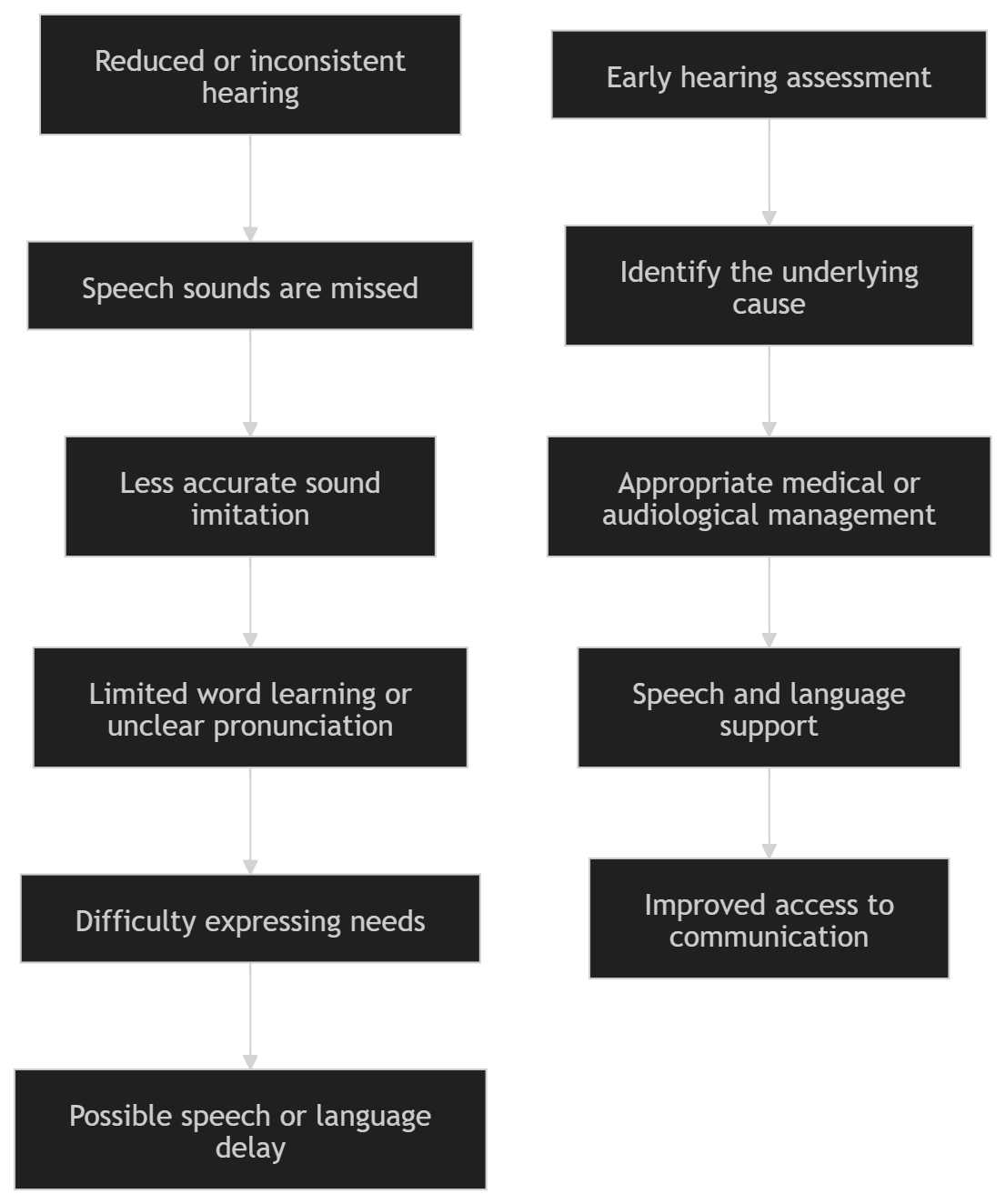
How Reduced Hearing Can Affect Speech Development

The developmental pathway can be represented simply:

The important point is that speech delay and hearing loss should not be treated as completely separate issues. A hearing assessment can either identify a hearing-related contributor or help clinicians move towards investigating other developmental causes.

What Counts as Speech or Language Delay?

Speech and language are related but different.

Speech concerns the physical production of sounds and words. A child may understand what is being said but have difficulty producing particular sounds.

Language concerns understanding and communicating meaning. This includes vocabulary, gestures, comprehension, sentence formation and the ability to communicate ideas.

A child can therefore have:

  • A speech delay
  • A language delay
  • Both speech and language difficulties
  • Hearing-related communication difficulties
  • A developmental condition affecting communication
  • A combination of several factors

For this reason, we should not attempt to diagnose the cause simply by counting how many words a child says.

The pattern of development matters just as much.

Speech Delay Milestones: When Should Parents Become Concerned?

Developmental milestones are useful reference points, but they are not a substitute for professional assessment.

Children develop at different rates. Nevertheless, a significant absence of expected communication behaviours should prompt discussion with a paediatrician, ENT specialist or audiologist.

Around 12 Months

Parents may become concerned if a child:

  • Is not babbling or making varied sounds
  • Rarely uses gestures such as pointing or waving
  • Does not consistently respond to sounds
  • Does not appear to recognise familiar voices
  • Shows little interest in communicating

The absence of communication behaviours is more important than simply whether a particular word has appeared.

Around 18 Months

A child may warrant assessment when they:

  • Have very limited spoken vocabulary
  • Rarely attempt to imitate sounds or words
  • Communicate almost exclusively through gestures
  • Have difficulty understanding simple spoken requests
  • Do not appear to respond consistently when called

The AAP identifies limited vocabulary and delayed word combinations among signs that can accompany hearing difficulties.

Around 2 Years

Parents should pay particular attention when a child:

  • Uses very few meaningful words
  • Does not begin combining words
  • Has difficulty understanding simple instructions
  • Relies heavily on gestures instead of speech
  • Has speech that is unusually difficult to understand
  • Appears unable to hear conversations unless they are very loud

At this age, we should look at both what the child can say and what the child can understand.

Around 3 Years

Further assessment becomes important when:

  • Speech remains very difficult for unfamiliar people to understand
  • The child’s vocabulary is noticeably behind peers
  • Simple instructions are difficult to follow
  • Communication frustration is frequent
  • The child avoids verbal interaction
  • The child repeatedly asks others to repeat themselves or watches faces closely when people speak

These signs do not establish a diagnosis. They establish a reason to investigate.


Hearing Loss in Children Does Not Always Look Like Hearing Loss

This is where many parents are caught off guard.

A child with hearing difficulty may not behave as though they cannot hear. Instead, they may develop strategies that compensate for reduced hearing.

For example, they may watch a parent’s face carefully, respond when someone approaches them from the front, or rely on visual clues to understand what is happening.

Parents may interpret this as normal behaviour.

Other signs can include:

  • Frequently increasing television or tablet volume
  • Responding inconsistently when called
  • Watching the speaker’s lips closely
  • Sitting unusually close to the television
  • Failing to notice quieter sounds
  • Difficulty understanding speech in noisy environments
  • Turning the head towards one side to hear
  • Frequently saying “what?” or asking for repetition in older children
  • Delayed speech or unclear pronunciation
  • Becoming frustrated during communication
  • Appearing inattentive when spoken to
  • Difficulty following verbal instructions

The AAP also lists excessive listening volume, difficulty locating sounds, unexplained behavioural changes and delayed speech or language development among signs that can warrant hearing evaluation.

Can Ear Infections Cause Speech Delay?

Yes, hearing can be temporarily reduced when fluid accumulates in the middle ear.

One of the most common conditions involved is otitis media with effusion (OME), sometimes called “glue ear.” Fluid sits behind the eardrum without necessarily producing the intense pain associated with an acute ear infection.

The result can be muffled hearing.

This matters because a child may have no obvious earache while still receiving a less-than-clear speech signal.

The American Academy of Pediatrics explains that middle-ear fluid can temporarily reduce hearing, while persistent hearing difficulties during early childhood can interfere with language development.

Why Are Young Children Particularly Susceptible to Middle-Ear Problems?

The Eustachian tube helps ventilate the middle ear and regulate pressure.

In young children, its anatomy and function make middle-ear ventilation less efficient than in adults. Respiratory infections and congestion can contribute to dysfunction, allowing fluid to remain behind the eardrum.

This can create a conductive hearing problem.

Importantly, conductive hearing loss caused by middle-ear fluid is not the same as permanent sensorineural hearing loss. The treatment, prognosis and follow-up can be very different.

That distinction is precisely why a proper hearing examination is more useful than trying to determine the cause from symptoms alone.

Does a Child Need a Hearing Test for Speech Delay?

In many cases, yes.

A hearing evaluation is particularly important when speech or language development is delayed and there is no obvious explanation.

We should not assume that a child can hear normally simply because they:

  • Respond to loud noises
  • Hear music
  • Notice someone entering a room
  • Respond occasionally to their name
  • Passed a newborn hearing screening

Hearing can change after birth.

The AAP recommends prompt hearing evaluation whenever concerns about a child’s hearing arise, including concerns raised by parents or caregivers.

Hearing Tests for Babies, Toddlers and Young Children

Children cannot always complete conventional adult hearing tests. Fortunately, paediatric audiology offers several objective and age-appropriate methods.

Tympanometry

Tympanometry assesses the movement and function of the eardrum and middle ear.

It can help identify problems such as:

  • Middle-ear fluid
  • Abnormal middle-ear pressure
  • Reduced eardrum mobility
  • Certain Eustachian tube problems

The test is quick and does not require the child to answer questions.

Otoacoustic Emissions (OAE)

OAE testing evaluates sound responses generated by the inner ear, particularly the cochlea.

A small probe is placed in the ear canal and presents sounds. The equipment measures the resulting response.

Because the test is objective, it can be useful for babies and young children who cannot reliably respond to conventional hearing tests.

Auditory Brainstem Response (ABR)

ABR measures electrical responses generated along the auditory pathway following sound stimulation.

Small electrodes are placed on the child’s head while sounds are presented through earphones or specialised equipment.

The child does not need to raise a hand or tell the audiologist what they heard.

For infants and children who cannot cooperate with behavioural testing, ABR can therefore provide valuable objective information. The AAP describes ABR as one of the objective approaches used when children are too young or unable to participate reliably in standard hearing assessments.

Behavioural Audiometry

As children become developmentally ready, audiologists can use age-appropriate behavioural techniques to determine hearing thresholds.

The exact method depends on:

  • Age
  • Developmental level
  • Attention
  • Communication ability
  • Previous hearing history
  • Whether testing can be completed reliably

There is no single hearing test that is appropriate for every child.

What Happens During a Speech Delay Evaluation?

A thorough assessment should investigate more than vocabulary.

A clinician may consider:

  1. Developmental history
  2. Pregnancy and birth history
  3. Newborn hearing-screening results
  4. Previous ear infections
  5. Family history of hearing difficulties
  6. Speech and language development
  7. Understanding of spoken language
  8. Social communication
  9. Behavioural observations
  10. Ear examination
  11. Audiological testing
  12. Speech-language assessment

This approach prevents a common mistake: treating the symptom without identifying the underlying cause.

If hearing is normal, the evaluation should not simply end. A child may need assessment by a speech-language pathologist, developmental paediatrician or another appropriate specialist.

What If the Hearing Test Is Normal?

A normal hearing test is good news, but it does not mean that a speech delay should be ignored.

If hearing is adequate, clinicians can investigate other possible contributors.

These may include:

  • Expressive language delay
  • Receptive language difficulties
  • Speech-sound disorders
  • Developmental differences
  • Autism spectrum disorder
  • Broader developmental delay
  • Oral-motor difficulties
  • Neurological conditions
  • Environmental and communication factors

The correct response to a normal hearing test is not “there is nothing wrong.”

The correct response is: now we know hearing is less likely to be the explanation, so the assessment can move forward.

Can a Child Have Hearing Loss in Only One Ear?

Yes.

Unilateral or single-sided hearing loss can be particularly difficult to identify because the child may hear reasonably well in quiet, familiar situations.

However, one-sided hearing difficulty can make it harder to:

  • Locate sounds
  • Understand speech in background noise
  • Follow group conversations
  • Hear a speaker from the affected side
  • Maintain listening attention

The AAP notes that children with single-sided hearing loss may have difficulty in noisy environments and may turn their head to hear better.

This is another reason why a proper audiological evaluation is preferable to informal “hearing checks” at home.

Speech Delay Treatment Depends on the Cause

There is no universal treatment for speech delay.

Treatment should follow the diagnosis.

Treating Middle-Ear Fluid

When OME is present, management depends on:

  • How long the fluid has persisted
  • Whether hearing is affected
  • Whether the child is at increased developmental risk
  • Whether recurrent infections are present
  • Whether language development is being affected

Many cases resolve without surgery. Clinical guidance supports observation in children who are not at increased risk, while persistent effusion and suspected hearing or language difficulties require appropriate hearing assessment and follow-up.

Hearing Aids for Permanent Hearing Loss

If testing identifies permanent hearing loss, paediatric hearing aids may be appropriate.

Modern hearing technology can provide children with access to speech sounds, but fitting a child is not simply a matter of placing an adult hearing aid on a smaller ear.

Paediatric amplification requires:

  • Accurate diagnostic testing
  • Appropriate device selection
  • Professional fitting
  • Regular verification
  • Ongoing hearing monitoring
  • Family education
  • Consistent follow-up
  • Communication and language support

Early access to appropriate hearing technology can support spoken-language development.

Speech and Language Therapy

Speech-language therapy may be recommended when a child has difficulty with:

  • Vocabulary
  • Understanding language
  • Sentence formation
  • Speech sounds
  • Pronunciation
  • Social communication
  • Expressive communication

If hearing loss contributed to the delay, improving access to sound and providing language therapy may need to happen together.

When Are Ear Tubes Considered?

Persistent middle-ear fluid does not automatically mean that surgery is required.

When fluid continues for an extended period, hearing is significantly affected, infections are recurrent, or the child is at developmental risk, an ENT specialist may consider tympanostomy tubes.

The procedure is commonly called:

  • Ear tube insertion
  • Tympanostomy tube placement
  • Ventilation tube insertion
  • Grommet insertion

The purpose is to ventilate the middle ear and reduce persistent fluid-related hearing problems.

The decision should be individualised rather than based solely on the number of months since an ear infection.

Speech Delay After Ear Treatment: What Should Parents Expect?

Improving hearing removes one potential barrier to communication, but it does not instantly teach a child every missed speech or language skill.

A child who has spent months hearing speech inconsistently may need time and structured support to develop:

  • New vocabulary
  • Accurate pronunciation
  • Listening skills
  • Sentence formation
  • Conversational confidence

Speech therapy can be particularly useful when communication skills have fallen behind.

The speed of improvement differs considerably between children because the underlying cause, severity, duration and developmental profile are different.

What Parents Should Not Do When a Child Has Speech Delay

Do Not Wait Indefinitely

“Every child develops differently” is true, but it should never become a reason to ignore persistent developmental concerns.

A professional assessment does not mean that a serious diagnosis will be made. It means potential problems can be identified or excluded.

Do Not Force Speech

Repeatedly demanding that a frustrated child “say it properly” can turn communication into a stressful experience.

Instead, adults can model words naturally, give the child opportunities to communicate and respond positively to attempts.

Do Not Put Oil or Other Substances Into the Ear

Home remedies involving substances placed inside the ear can be dangerous, particularly when the eardrum is perforated or its condition is unknown.

An ear examination should come before attempting to treat an unexplained ear problem.

Do Not Blame Bilingualism

Growing up with two or more languages does not automatically explain a significant communication delay.

Multilingual children can develop language across multiple languages, and assessment should consider the child’s overall communication rather than judging development through only one language.

Do Not Diagnose Autism or Another Condition Based on Speech Alone

Speech delay can occur for many reasons.

A child who speaks late should receive an appropriate developmental assessment rather than being assigned a diagnosis based on a single symptom.

When Should Parents Seek Urgent Medical Attention?

Most speech delays do not constitute a medical emergency.

However, certain symptoms deserve prompt medical evaluation.

Seek medical attention when a child:

  • Loses previously acquired words or communication skills
  • Develops sudden hearing difficulty
  • Has blood, pus or significant fluid coming from the ear
  • Develops severe ear pain with fever
  • Becomes unusually distressed with signs of ear infection
  • Suddenly stops responding to sounds
  • Experiences a sudden change in behaviour associated with possible hearing difficulty

Regression is particularly important. A child who loses previously acquired communication abilities should be evaluated rather than simply observed at home.

Can Screen Time Cause Speech Delay?

Screen exposure should not be used as a universal explanation for speech delay.

The more important issue is what screen use replaces.

Language develops through interaction. Children need opportunities to:

  • Hear adults speak
  • Take turns communicating
  • Look at faces
  • Respond to questions
  • Point and gesture
  • Play interactively
  • Hear words associated with real objects and experiences

Excessive passive screen use can reduce these opportunities, but a child with significant speech delay still deserves proper hearing and developmental assessment rather than simply having screen time reduced.

Can a Late Talker Eventually Catch Up?

Some children who talk later than their peers do catch up.

That possibility should not be confused with a reason to postpone assessment.

A child may have a temporary hearing problem, an expressive language delay or another developmental difference. The earlier the underlying issue is recognised, the sooner appropriate support can begin.

The AAP emphasises that early identification and support are important because early childhood is a critical period for language acquisition and development.

The most useful question is therefore not:

“Will my child eventually start talking?”

It is:

“Why is my child not developing speech as expected, and has hearing been properly assessed?”

Speech Delay and Hearing Loss: A Practical Parent Checklist

If you are concerned about your child’s speech, consider the following:

Question What to consider
Does your child respond consistently to their name? In quiet and noisy environments
Does your child react to soft sounds? Not just loud noises
Does your child babble and imitate sounds? Consider age and developmental stage
Is speech development progressing? Look for change over time
Does your child understand simple instructions? Receptive language matters
Does your child watch your lips closely? Could indicate reliance on visual cues
Is the television unusually loud? A possible hearing warning sign
Are there recurrent ear infections? Discuss with an ENT specialist
Has hearing been formally assessed? Do not rely only on home observation
Has speech-language development been assessed? Especially if hearing is normal

Frequently Asked Questions About Speech Delay and Hearing Problems

Can hearing loss cause a child not to talk?

Yes. Hearing difficulty can interfere with a child’s ability to hear and imitate speech sounds and learn spoken language. Even temporary hearing reduction from middle-ear fluid can affect communication during important developmental periods.

Should every child with speech delay have a hearing test?

A hearing evaluation is an important part of assessing unexplained speech or language delay, particularly when there are signs suggesting reduced hearing. Professional assessment can identify hearing problems that are not obvious from everyday behaviour.

Can a child hear but still have hearing loss?

Yes. Hearing loss is not necessarily complete deafness. A child may hear some sounds while struggling with others, or may have hearing loss in only one ear.

Can ear fluid affect speech development without causing pain?

Yes. Middle-ear fluid can occur without an acute painful infection and can reduce hearing. Persistent fluid therefore deserves appropriate monitoring, particularly when speech, language or learning concerns are present.

What is the best hearing test for a toddler?

There is no single best test for every toddler. Tympanometry, OAE, ABR and age-appropriate behavioural audiometry may all have roles depending on the child’s age, development and clinical situation.

Does passing a newborn hearing screening guarantee normal hearing later?

No. A newborn screening assesses hearing at that point in time. Children can develop hearing difficulties later, which is why new concerns should be investigated rather than dismissed because a child passed their newborn screening.

Should parents wait until preschool if a child is not talking?

No. Persistent concerns about speech or hearing should be discussed before preschool. Early identification provides an opportunity to address hearing, speech and language needs during an important period of development.

Can speech therapy help if the child has hearing loss?

Yes, speech-language therapy can form an important part of communication support. However, the child also needs appropriate access to communication, which may involve medical treatment, hearing technology, auditory support or other communication approaches depending on the type and severity of hearing difficulty.

When Speech Delay Needs a Hearing Check, Not Just More Time

A child who speaks later than expected should not be judged by comparison alone. What matters is whether communication is progressing appropriately and whether the child can reliably access spoken language.

Hearing should be investigated early because the signs can be subtle. A child may respond to loud sounds, enjoy music and appear attentive while still struggling to understand speech.

The solution is not to assume that every late talker has hearing loss. Nor is it reasonable to assume that every late talker will simply catch up.

The stronger clinical approach is to test hearing, examine the ears, assess speech and language, identify the underlying cause and intervene according to the child’s individual needs.

For parents, that distinction can make the difference between months of uncertainty and a clear, evidence-based plan for supporting communication development.

If your child is experiencing delayed speech, inconsistent responses to sounds, recurrent ear problems or difficulty understanding spoken language, arrange an evaluation with an appropriate paediatrician, ENT specialist or audiologist rather than relying on observation alone.

At Soundrich Hearing, we understand that delayed speech can leave parents with many questions, especially when hearing may be a contributing factor. Our team provides professional hearing evaluations using advanced audiology equipment to identify possible hearing difficulties in children and adults. Early identification can help parents take the right next step, whether that involves further ENT evaluation, hearing support or speech and language intervention. With expert guidance, personalised care and convenient hearing services, Soundrich Hearing is committed to helping families make informed decisions about better hearing and communication.


Leave A Reply Cancel reply

Your email address will not be published. Required fields are marked *

*

*

Hearing Loss Worsening This Fall
Is Your Hearing Loss Worsening This Fall? When to Seek a Hearing Specialist
Previous Article
  • Archives

    • August 2026
    • July 2026
    • June 2026
    • May 2026
    • April 2026
    • March 2026
    • February 2026
    • January 2026
    • December 2025
    • November 2025
    • October 2025
    • September 2025
    • August 2025
    • July 2025
    • June 2025
    • May 2025
    • April 2025
    • March 2025
    • February 2025
    • January 2025
    • December 2024
    • November 2024
    • October 2024
    • September 2024
    • August 2024
    • July 2024
    • June 2024
    • May 2024
    • April 2024
    • March 2024
    • February 2024
    • January 2024
    • December 2023
    • November 2023
    • October 2023
    • September 2023
    • August 2023
    • July 2023
    • April 2023
    • March 2023
    • February 2023
    • January 2023
    • December 2022
    • October 2022
    • April 2019


Request Appointment

If you're struggling to hear, don't wait any longer. Request an appointment for sound aid hearing today and get the help you need.
Get In Touch

We help our clients hear again

We are driven by the values of customer centricity and integrity. We will always have your best interests in our heart while dealing with you.

Read More
Facebook Instagram Linkedin Google

Explore

Home
About Us
Product
Services
Learn
Centre Location
Contact

Other Links

Disclaimer
Privacy Policy
Terms of Service

Soundrich Hearing Pvt. Ltd.

Dwarka

Flat No. 63, Ground Floor,
Sunview Apartment, Pocket-4,
Sector-11, Dwarka,
New Delhi – 110075

Uttam Nagar

info@soundrichhearing.com

E-9, Flat No. – 101,
Om Vihar Extension, Uttam Nagar,
Delhi – 110059

Janakpuri

Shop No. 1/105, Block C4E,
Near C4E Bus Stop,
Janakpuri,
New Delhi – 110058

Copyright 2026 to Soundrich Hearing All Right Reserved | Designed & Developed By Soundrich Hearing
WhatsApp
Hello👋! Thank you for choosing Soundrich Hearing. How can we help you?
Open chat